
Enterprise AI foundations: data, cloud architecture, MLOps and governance
Most failed AI programmes did not fail at the model. They failed because nobody could get the data out of the source system, nobody could redeploy the pipeline without the one engineer who built it, and nobody could answer the auditor's question about what the system did on 14 March.
Pilots run on hand-assembled extracts. Nothing is reproducible. Then a security review, an audit, or an EU AI Act obligation arrives and the whole programme stalls while people retrofit governance onto something that was never designed for it.
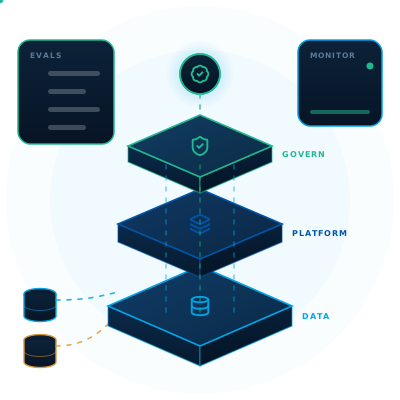
A reproducible platform: versioned data, versioned models, environments that can be rebuilt from code, monitoring that fires before your users notice, and an audit trail that answers questions instead of raising them.
Core use cases
Architecture & migration
Well-Architected designs on AWS or Azure, sized for your real workload rather than a reference diagram, with cost controls set before the bill arrives.
Model lifecycle management
CI/CD for models versioned training, staged deployment, rollback that works, and monitoring you configured on purpose.
Pipelines & quality
Ingestion, transformation and contract testing so downstream models fail loudly at the source rather than silently at the output.
AI risk & audit trail
Model inventory, access policy, evaluation records and decision logs mapped to the NIST AI Risk Management Framework and EU AI Act obligations.
How it works
We are deliberately unromantic about tooling. These are the components that have survived production across our deployments chosen because they work under load and can be handed over, not because they are new. The panel alongside shows the kind of interface this pillar actually produces.
- AWS Advanced Tier Services Partner Bedrock, SageMaker, Well-Architected
- Azure OpenAI, Databricks and Snowflake
- Infrastructure as code, containerised deployment on Kubernetes
- Observability, evaluation harnesses and incident runbooks
- AI governance mapped to NIST AI RMF and EU AI Act
Other capabilities
Agentic Workflow Orchestration
Multi-agent systems that plan a multi-step process, call the right tools, and execute it end to end with human checkpoints only where they earn their place.
Document & Data Intelligence
Agents that read, extract, validate and route unstructured documents invoices, claims, contracts, scanned forms and pipe clean structured data downstream.
Conversational & Generative AI
LLM copilots for customers, employees and partners grounded in your own enterprise data through retrieval, with citations and guardrails on every answer.
Applied ML & Predictive Intelligence
Forecasting, anomaly detection, risk scoring and recommendations the analytical judgement an agent needs before it is allowed to act on anything.
Common questions
Have a candidate process in mind?
Send us the shape of it. We will come back with whether this pillar is the right fit, a realistic timeline, and what it would be scoped as.