
Document intelligence agents that read, validate, and route your unstructured data
The majority of enterprise information still arrives as a PDF, a scan, or a photograph of a form taken on someone's phone. Traditional OCR reads the characters and stops. Our agents read the document, understand what it is, check it against your rules, and decide what should happen to it next.
A team of people opens attachments all day, types numbers into a system, and spots errors by eye. Volume grows, the team does not, and the backlog becomes a customer-experience problem before it becomes a cost problem.
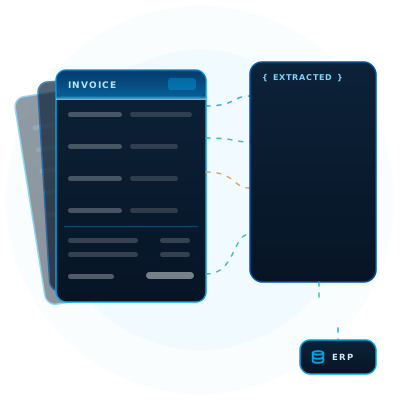
A pipeline that takes documents in any layout, returns structured fields with per-field confidence scores, auto-processes what it is sure about, and puts only genuinely ambiguous cases in front of a reviewer.
Core use cases
Invoice & PO extraction
Handles layouts it has never seen, matches lines against the purchase order, flags the mismatches, and posts the clean ones straight through.
Contract field validation
Pulls the clauses and dates that matter, checks them against your standard positions, and surfaces only the deviations for counsel to read.
Vision inspection agent
Runs computer vision on the line to catch defects in real time and route flagged units for review instead of relying on periodic spot checks.
Structured pipeline agent
Turns messy real-world scans into a validated, schema-conformant feed your warehouse and downstream models can actually trust.
How it works
We are deliberately unromantic about tooling. These are the components that have survived production across our deployments chosen because they work under load and can be handed over, not because they are new. The panel alongside shows the kind of interface this pillar actually produces.
- Layout-aware IDP and OCR ensembles
- Vision-language models for photographed and low-quality scans
- Per-field confidence scoring with tunable thresholds
- Business-rule and cross-document validation
- Straight-through processing with exception queues
Other capabilities
Agentic Workflow Orchestration
Multi-agent systems that plan a multi-step process, call the right tools, and execute it end to end with human checkpoints only where they earn their place.
Conversational & Generative AI
LLM copilots for customers, employees and partners grounded in your own enterprise data through retrieval, with citations and guardrails on every answer.
Applied ML & Predictive Intelligence
Forecasting, anomaly detection, risk scoring and recommendations the analytical judgement an agent needs before it is allowed to act on anything.
Enterprise AI Foundations
Data engineering, cloud architecture, MLOps and governance the unglamorous layer that decides whether anything above it survives its second year.
Common questions
Have a candidate process in mind?
Send us the shape of it. We will come back with whether this pillar is the right fit, a realistic timeline, and what it would be scoped as.