
Applied machine learning and predictive intelligence for operating decisions
An agent is only as good as the judgement it can call on. When the decision is numerical how much to make, which transaction to hold, which machine to service first a purpose-built model beats a language model every time. We build those models, and we build them to survive contact with production.
A promising notebook produces a strong backtest, then never ships. Or it ships, drifts quietly for six months, and nobody notices until the forecast is wrong in a way that costs real money.
A deployed model with monitored inputs, tracked drift, a documented retraining trigger, and a clear line from its output to a decision somebody actually makes.
Core use cases
Demand & risk forecasting
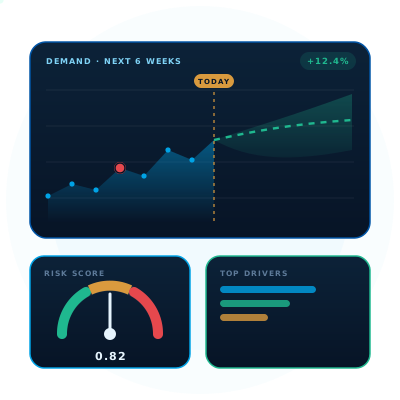
SKU-level forecasts with explicit uncertainty ranges, so planners can see where the model is confident and where it is guessing.
Anomaly & fraud scoring
Scores transactions and events in real time against learned normal behaviour, tuned to your tolerance for false positives.
Predictive maintenance
Uses sensor and maintenance history to flag equipment likely to fail inside a defined window, so servicing is scheduled rather than reactive.
Recommendation engine
Ranks products, offers or next-best actions from behavioural signals, with guardrails on margin and inventory.
How it works
We are deliberately unromantic about tooling. These are the components that have survived production across our deployments chosen because they work under load and can be handed over, not because they are new. The panel alongside shows the kind of interface this pillar actually produces.
- Time-series forecasting with uncertainty quantification
- Gradient boosting, deep learning and classical statistical models
- Feature stores and reproducible training pipelines
- Drift monitoring and automated retraining triggers
- Model explainability for regulated decisions
Other capabilities
Agentic Workflow Orchestration
Multi-agent systems that plan a multi-step process, call the right tools, and execute it end to end with human checkpoints only where they earn their place.
Document & Data Intelligence
Agents that read, extract, validate and route unstructured documents invoices, claims, contracts, scanned forms and pipe clean structured data downstream.
Conversational & Generative AI
LLM copilots for customers, employees and partners grounded in your own enterprise data through retrieval, with citations and guardrails on every answer.
Enterprise AI Foundations
Data engineering, cloud architecture, MLOps and governance the unglamorous layer that decides whether anything above it survives its second year.
Common questions
Have a candidate process in mind?
Send us the shape of it. We will come back with whether this pillar is the right fit, a realistic timeline, and what it would be scoped as.