
Enterprise conversational AI agents grounded in your own data
A general-purpose chatbot knows the internet. It does not know your pricing rules, your policy exceptions, or what your ops lead decided in March. We build copilots that retrieve from your actual sources, cite what they used, and decline when the answer is not there.
Teams pilot a chatbot, it hallucinates a policy answer in front of a customer, and the project quietly dies. The failure is almost never the model it is the absence of a retrieval layer, an evaluation harness, and a refusal policy.
A grounded assistant with measured answer quality, source citations on every response, a defined refusal behaviour, and a feedback loop that improves retrieval where it is genuinely weak.
Core use cases
Support copilot
Drafts responses from your knowledge base and ticket history, cites its sources, and hands off to an agent the moment it is out of its depth.
NL2SQL query agent
Business teams ask a question in plain language; the agent writes the query, validates it against the schema, runs it, and shows its work no analyst queue.
Content generation agent
Produces on-brand drafts from approved source material and templates, with review built into the workflow rather than bolted on.
Knowledge assistant
Answers policy, process and product questions across SharePoint, Confluence and Drive with permissions respected at retrieval time.
How it works
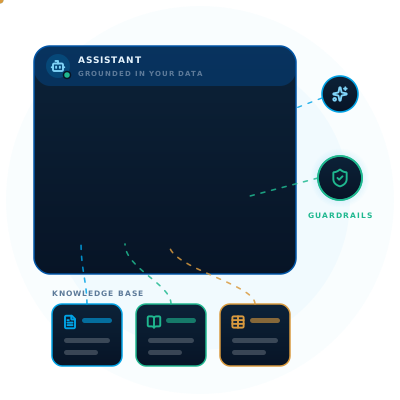
We are deliberately unromantic about tooling. These are the components that have survived production across our deployments chosen because they work under load and can be handed over, not because they are new. The panel alongside shows the kind of interface this pillar actually produces.
- Retrieval-augmented generation with hybrid search
- Vector databases and re-ranking
- Permission-aware retrieval and row-level access control
- Groundedness evaluation and regression testing
- Refusal policy, PII redaction and prompt-injection defence
Other capabilities
Agentic Workflow Orchestration
Multi-agent systems that plan a multi-step process, call the right tools, and execute it end to end with human checkpoints only where they earn their place.
Document & Data Intelligence
Agents that read, extract, validate and route unstructured documents invoices, claims, contracts, scanned forms and pipe clean structured data downstream.
Applied ML & Predictive Intelligence
Forecasting, anomaly detection, risk scoring and recommendations the analytical judgement an agent needs before it is allowed to act on anything.
Enterprise AI Foundations
Data engineering, cloud architecture, MLOps and governance the unglamorous layer that decides whether anything above it survives its second year.
Common questions
Have a candidate process in mind?
Send us the shape of it. We will come back with whether this pillar is the right fit, a realistic timeline, and what it would be scoped as.